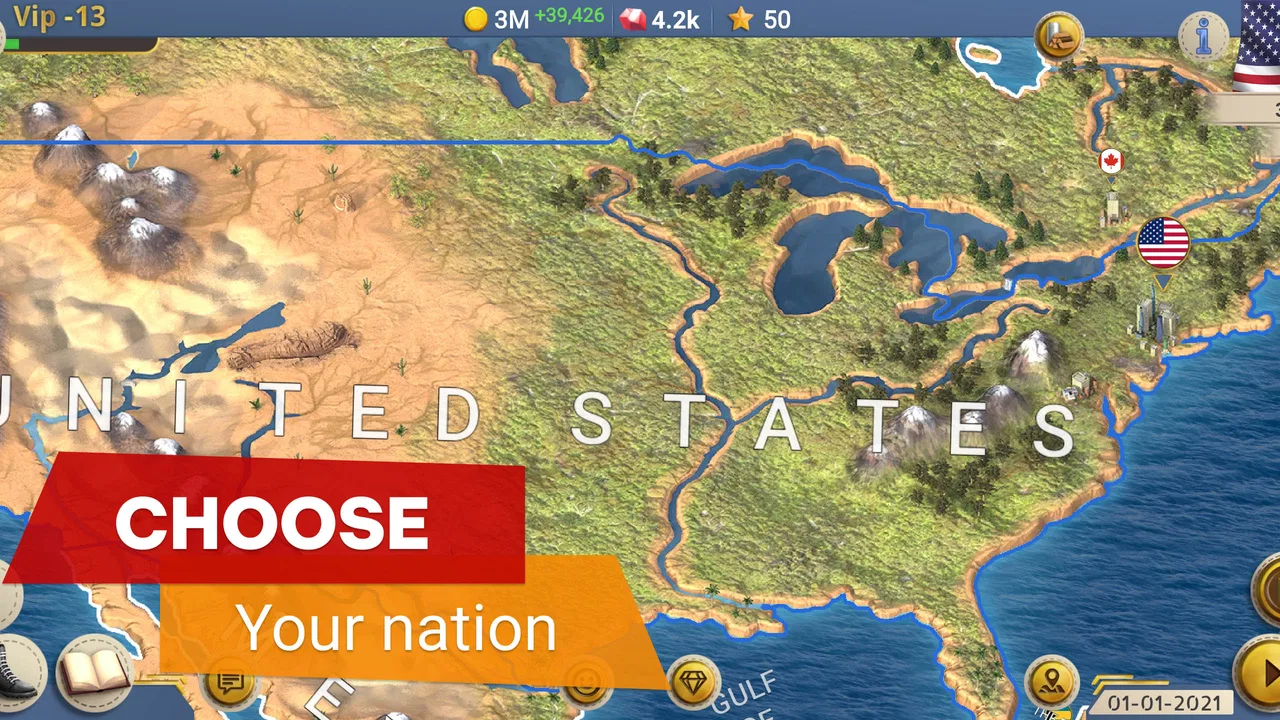
MA 2 – President Simulator
- 4.4
- Rating
- 10.00M
- Installs
- Free
- Price

 Analysis by App-foxy
I approached MA 2 – President Simulator as a decision rather than a quick download: is it the right kind of strategy game for the way you like to spend short or long sessions? Its central appeal is clear. You step into the role of a national leader, make political and military choices, develop a country, and pursue greater power. The interesting part is not simply winning a battle; it is balancing the consequences of several decisions that can pull your country in different directions.
That makes it a better fit for players who enjoy planning, pressure, and long-term trade-offs than for anyone looking for a fast action game. I found myself thinking less about individual moves and more about what each decision would leave me able to do later. The free entry point helps make it easy to try, while optional purchases ranging from $0.49 to $99.99 per item mean that players who dislike in-game spending should approach it with a little caution.
How to decide whether this strategy game fits you
The first question is what you expect from a president simulator. If you want a detailed political sandbox where every institution, law, and social group is modeled with deep realism, this may feel more focused and game-like than a full simulation. If you want a mobile strategy experience built around national power, warfare, and choosing priorities under pressure, it has a much stronger case.
You May Also Like

 Blood Strike: 2.5 Anniversary
Blood Strike’s Loadouts Turn Every Drop Into a Tactical Gamble
A close look at Blood Strike’s custom loadouts: how fast access to signature weapons reshapes its battle royale rhythm, rewards preparation, and narrows the gap between fights.

 Pandora - Music & Podcasts
Pandora’s Music Is Easy to Start, but Harder to Recover
Pandora’s strength is its low-effort path from a seed to a station. Its weak spot is how much confidence it asks you to place in connection, setup, and quiet recovery.

 8 Ball Pool
 Is Built on Rivalries, Rematches, and Routine
A close look at the rivalries, rematches, shared routines, and unanswered safety questions that turn a quick pool match into a persistent mobile community.

 Samsung Music
’s Quiet Strength Is Playing What You Already Own
Its reach comes less from spectacle than from dependable access to a personal library. That simplicity is both the app’s strongest retention engine and its ceiling.

 AccuWeather: Weather Radar
AccuWeather Review: A Quick, Clear Forecast for Everyday Decisions
For everyday plans, the best forecast is the one you can understand quickly. AccuWeather makes rain timing, radar, and local conditions easy to act on, with a few trade-offs.

 Hill Climb Racing
Why Hill Climb Racing Still Turns Crashes Into One More Run
A tiny car, a bumpy hill and one more upgrade: Hill Climb Racing keeps resurfacing because its simple chaos makes every near-miss feel personal.
More From Our News Desk



I would also consider your preferred session length. This is not the kind of game I would recommend only for a two-minute distraction. Even when a session begins casually, the decisions invite follow-up thinking: should resources support military strength, national development, or preparation for a future conflict? The game is most enjoyable when I have enough attention to remember what I was trying to achieve and why a particular choice mattered.
The basic premise gives the game a useful identity. You are not managing a single squad or arranging a small settlement; you are trying to guide an entire country toward strength. That wider viewpoint changes the rhythm. A successful move in one area can create a problem somewhere else, and an aggressive plan may be attractive while still demanding preparation. The main skill is prioritization, not simply selecting the most powerful-looking option.
It also helps to know what kind of atmosphere you are comfortable with. The game includes nuclear weapons and war as part of its strategic setting, so the subject matter is more serious than a harmless city-building game. Its Everyone content rating makes it broadly accessible, but the strategic theme still may not suit younger players or families looking for a purely peaceful experience.
On the technical side, the game supports Android devices running version 7.0 or later. That gives it a reasonably broad reach, particularly for people who do not own a recent phone. The current version is 1.0.160, and the title comes from Oxiwyle Inc, a developer associated here with a strategy game rather than a casual puzzle experience. I would still judge the experience by your device’s comfort and screen size, because management games can feel cramped when menus and information compete for attention.
Its audience is already substantial: the game has passed ten million installs, with an average rating of 4.4 from around 231 thousand ratings and roughly 2 thousand written reviews. I do not treat popularity as proof that every player will enjoy it, but those figures do suggest that the national-leadership formula has found a sizeable mobile audience. For me, that makes it worth trying, especially because the download itself is free.
What I look for during the first session
My first test with a strategy game is whether its choices feel connected. A menu full of actions is not enough; I want to understand why one decision changes the next. In this game, I recommend resisting the urge to treat every available option as equally urgent. Pick a broad objective first, then use the early decisions to support it instead of scattering attention across unrelated goals.
A practical opening routine is to examine your position before committing to an ambitious military plan. Ask what you can sustain, what you need to strengthen, and which actions might close off another route. This sounds simple, but it is one of the easiest ways to avoid wasting a session on decisions that look impressive but do not support a coherent national strategy.
I also found it useful to pause mentally after major choices rather than tapping through everything as quickly as possible. The game becomes more readable when I treat each action as part of a sequence. If I am preparing for conflict, I want the surrounding decisions to serve that preparation. If I am trying to build a stronger country, I do not want every move to be judged only by immediate military gain.
That approach reveals one of the less obvious strengths of the design: it encourages planning in layers. The first layer is the goal, such as expansion or national strength. The second is the preparation needed to make that goal realistic. The third is the damage control required when the plan meets resistance. Players who enjoy these layers will likely get more from it than players who only want a clear upgrade path.
Where MA 2 makes the strongest case
The biggest strength is the scale of the role. Many mobile strategy games ask me to improve a base, arrange a team, or win a sequence of battles. Here, the fantasy is broader: I am responsible for the direction of a nation. That creates more meaningful tension because a choice can be evaluated as part of a national agenda rather than as an isolated tactical trick.
The combination of leadership, warfare, and nuclear strategy gives it a sharper identity than a generic resource-management game. Nuclear weapons are not just decorative in the premise; they establish a world where deterrence, threat, and escalation are part of the mental framework. I would not recommend treating that theme as a simple shortcut to victory. The more interesting question is how the possibility of overwhelming force changes the decisions around it.
Another advantage is its accessibility. A free game with an Everyone rating and support for Android 7.0 or later is easy to test without committing money or replacing a newer device. That matters for this genre because strategy games can look appealing in screenshots but reveal their real rhythm only after several sessions. I can try the core experience first and decide whether its pace suits me.
The game also works well for players who like replaying decisions in their head. After a session, I often know exactly where a plan began to drift: an overconfident military choice, a delayed preparation step, or an attempt to pursue too many objectives at once. That self-review is part of the entertainment. The game gives me reasons to ask what I would change next time, which is more valuable than a system that simply hands out upgrades without demanding judgment.
For an everyday scenario, imagine having a quiet commute or a break between tasks and wanting something more engaging than a match-three game. I would use this title when I have enough time to make a few connected decisions, then leave with a clear idea of what I want to try in the next session. It suits that middle ground between a quick mobile diversion and a demanding desktop strategy game.
My most useful tip is to define a win condition for yourself before opening every decision screen. The game’s broad premise can tempt you to chase whatever looks strongest in the moment. Instead, decide whether the current phase is about preparation, expansion, recovery, or consolidation. That personal framework makes the available choices easier to judge and reduces the feeling of wandering through menus.
A second tip is to treat military power as a tool rather than the entire identity of your country. The store summary emphasizes war and nuclear weapons, but the strategy becomes more interesting when I consider what those tools are supposed to achieve. A powerful move that leaves no room for the next stage may be less useful than a quieter decision that preserves options.
A third insight is that the game is probably most rewarding when played with a willingness to accept imperfect outcomes. If you reload mentally after every setback and expect every plan to work cleanly, the pressure can feel frustrating. I prefer using a setback as information: it shows which part of my plan was too ambitious or poorly timed. That mindset turns mistakes into a reason to continue rather than an immediate reason to quit.
Where another strategy category may suit you better
This game is not the best choice for everyone who searches for a strategy title. If your favorite alternative is a fast real-time battle game, you may find the presidential perspective too indirect. The satisfaction here comes from directing a country and weighing consequences, not from controlling individual units with rapid taps or reacting to every second of a live match.
Players who prefer peaceful builders should also think carefully before installing it. A traditional city-building game usually makes growth, layout, and visual improvement the main reward. This title places national power and conflict much closer to the center. Even if you enjoy development systems, the military and nuclear setting may make it feel more confrontational than the alternative you normally choose.
There is another important distinction from grand strategy games designed for long sessions on a computer. Those games often provide an enormous amount of historical, diplomatic, economic, and administrative detail. A mobile president simulator has to present its decisions more directly. If your enjoyment depends on controlling every small institution or studying a highly granular model, a deeper desktop alternative may be a better home for that interest.
On the other hand, people who find large PC strategy games intimidating may prefer this format. The national scale remains appealing without requiring the same commitment to a keyboard, a large display, or a long uninterrupted campaign. I would choose it when I want the feeling of making consequential national decisions but still want a game I can pick up on a phone.
The cost model is another point of comparison. The game is free to install, but purchases are available inside it, from small amounts up to $99.99 for an item. I would not assume that spending is necessary, but I would decide in advance how I want to handle optional purchases. Setting a personal limit is sensible, particularly if the game’s strategic pressure makes a shortcut feel tempting after a setback.
This is also where the free model changes the decision. With a paid strategy game, I expect to understand the value before downloading because the initial commitment is fixed. Here, the financial commitment can begin at zero and grow later. That is convenient for trying the game, but it means the real cost of switching from “just testing it” to “investing in it” depends on your own habits.
The practical cost of switching to this game
Switching from a familiar strategy game is not only about learning controls. It means adjusting to a different definition of progress. In a city builder, I might judge success by visible expansion. In a tactical game, I might focus on winning the next encounter. In this title, I have to think more like a leader: what does this decision do for the country’s position several steps from now?
That change can be rewarding, but it does require patience. New players may initially choose actions because they sound powerful rather than because they fit a plan. I would give the game several focused sessions before deciding that it lacks depth. At the same time, I would not force myself to continue if I already know that I dislike indirect strategy or political-military themes.
There is a small mental cost to returning after a break. Because the experience depends on connected decisions, forgetting the purpose of an earlier plan can make the next session feel less clear. My solution is to end a session with a simple note to myself: what I was trying to accomplish, what problem appeared, and what I intended to address next. That habit makes the game easier to resume than tapping back in without context.
For players concerned about age suitability, the Everyone rating makes the game broadly approachable from a store-classification perspective. Still, I would explain the premise before handing it to a child, because nuclear weapons and warfare are central themes even when the presentation is strategic rather than graphic. For adults, the more relevant question is whether that subject matter feels thoughtful and engaging or simply too heavy for a casual mobile game.
Another switching issue is attention. This is not the right download if you want a game that can be played entirely on autopilot while watching something else. The decisions lose some of their value when I stop considering their consequences. It works better as a focused break, a commute activity, or an evening game than as background tapping.
Who should install it and who should skip it
I recommend trying it if you enjoy national strategy, long-term planning, and the tension between military ambition and sustainable progress. It is especially suitable for someone who wants a mobile game with a clear leadership fantasy rather than a small-scale combat loop. The free price makes that recommendation easy: you can test the rhythm before deciding whether it deserves a regular place on your phone.
I would also point it toward players who like discussing alternate decisions with themselves. Did you expand too quickly? Did you prepare enough before escalating? Would a less dramatic choice have left more options open? Those questions are where the game earns its place for me. It is not just about reaching a stronger position; it is about understanding how the route there shaped the next problem.
I would skip it if you want a purely peaceful builder, a reflex-focused battle game, or a highly detailed historical simulator. I would also be cautious if optional purchases regularly make free-to-play games stressful for you. Even without assuming how much spending is required, the broad purchase range means this is a title to approach with clear boundaries rather than impulse.
The developer, Oxiwyle Inc, has positioned the game around a very specific fantasy: national leadership under the shadow of war and overwhelming weapons. That focus is its advantage and its limitation. It gives the game a memorable identity, but it also narrows the audience compared with a general-purpose strategy game that avoids political or military themes.
My recommendation after weighing the trade-offs
My final recommendation is to try it if you want a free, mobile-first strategy experience that asks you to think beyond the next move. I like the way its president role gives ordinary decisions a broader consequence, and I appreciate that the game can be approached in short focused sessions without losing the appeal of long-term planning.
I would begin without spending, establish a personal purchase limit, and judge the game by whether its decision-making remains interesting after the initial novelty of leading a country wears off. Pay attention to whether you enjoy preparing for outcomes, not just reacting to them. That is the clearest test of whether this title belongs in your library.
For me, the strongest reason to recommend it is not the promise of becoming powerful; it is the tension involved in deciding what kind of power to pursue and when. The weakest point is that players seeking either a peaceful builder or a highly granular grand strategy game may feel that the focus sits between those categories. If that middle ground sounds appealing, MA 2 – President Simulator is worth a careful download rather than an automatic pass.
It is free, rated Everyone, and available for Android 7.0 or later, so the barrier to testing it is low. Just approach it as a strategy game about priorities and consequences, not as a simple war-themed tapper. That expectation made my sessions more satisfying, and it is the best way I can recommend the game to a friend.
FAQs for MA 2 – President Simulator
01What is MA 2 – President Simulator about?
MA 2 – President Simulator is a strategy game where you assume the role of a country's president. You'll manage various aspects such as economy, military, and diplomacy. The game challenges you to make strategic decisions to maintain stability and expand your influence globally. It's a deep simulation offering a blend of realism and entertainment.
02Is MA 2 – President Simulator free to play?
While MA 2 – President Simulator offers a free-to-play model, it includes in-app purchases that can enhance gameplay. These purchases can unlock additional features or provide resources. However, players can still enjoy a substantial portion of the game without spending any money, making it accessible to a broad audience.
03What platforms is MA 2 – President Simulator available on?
MA 2 – President Simulator is available on both Android and iOS platforms. Users can download it from the Google Play Store and the Apple App Store. This cross-platform availability ensures that a wide range of users can access and enjoy the game on their preferred devices.
04Does MA 2 – President Simulator require an internet connection?
MA 2 – President Simulator requires an internet connection for certain features, such as updates and online interactions. However, the core gameplay can be enjoyed offline, allowing players to manage their virtual presidency without needing constant connectivity, which is ideal for users on the go.
05How complex is the gameplay in MA 2 – President Simulator?
The gameplay in MA 2 – President Simulator is quite complex, involving strategic decision-making across various sectors like politics, economy, and international relations. It's designed for players who enjoy in-depth simulations and are looking for a challenging experience that requires careful planning and foresight.
Pros
- Realistic political scenarios
- Diverse strategy options
- Intuitive user interface
- Challenging decision-making
- Regular updates and improvements
Cons
- Steep learning curve
- Resource management can be complex
- Occasional performance lags
- Limited tutorial guidance
- In-app purchases may be necessary

MA 2 – President Simulator
Gallery